

Old State House
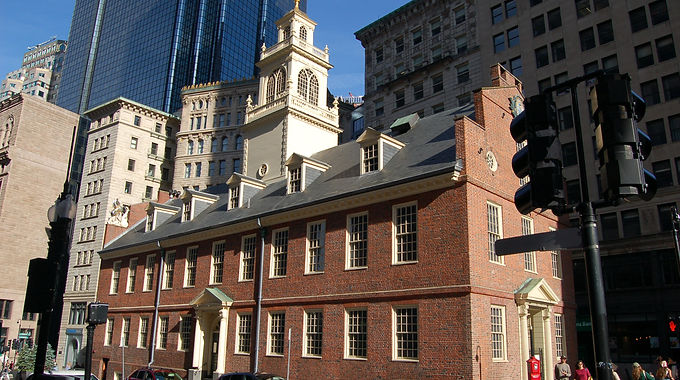
A Brief History: The Old State House, located at 206 Washington Street, is the oldest surviving public building in Boston, Massachusetts. It was built in 1713 after a fire destroyed the original building. The Old State House was an essential town building, used for trade as well as colonial and state government. In the mid 1700s while under the king’s rule, frustrations were beginning to rise between the Colonists and British. It was in the courts of the building where a lot of this tension came to light. In fact, James Otis Jr. better known for his famous phrase “Taxation without Representation is tyranny", challenged British Parliament over the legality of the Writs of Assistance in 1761. This order allowed the authorities to enter one’s home without probable cause. He ended up losing the case but became an influential figure that inspired Colonists to fight for their independence from British control. In 1768, as frustrations grew over British tariffs, Colonists began to boycott their goods in an attempt to protest the unfair taxes. Merchant shops in the area who proceeded to sell British goods despite the boycott were met with posted signs, calling them “Importers”. Orders for more British troops were ordered to try to control the situation but only made matters worse. In 1770, tensions were at an all-time high after the recent killing of 11-year-old Christopher Seider. Seider was killed by a Loyalist, Ebenezer Richardson, after a colonist in a crowd of protesters threw a rock at Richardson’s window, breaking it and hitting his wife. He fired his musket into the crowd in retaliation, hitting the young boy killing him later in the evening. The funeral proceedings had a turnout of approximately 2000 people. His death became a highly politicized event that would fuel the outrage of the colonists further.
On March 5th, 1770, a wig makers apprentice, Edward Garrick (13), wrongfully accused Captain-Lieutenant John Goldfinch of not paying a debt. Goldfinch ignored the boy’s insult as the debt had previously been paid. Witnessing the confrontation, a guard, Private Hugh White urged the boy to be more respectful. This led to a tense back and forth argument that drew in attention of protesters. The guard saw this as a reason to leave his post, hitting Garrick in the head, making him cry. As the day went on, a group of a few hundred colonists would gather in the square outside of the Old State House. Riled up from years of tension, they began throwing snowballs, among other objects at the British soldiers. One British soldier accidentally fired his musket, which led to the other soldiers to follow suit without direct order from the British officer Captain Thomas Preston. Three were killed instantly by the gunshots and two more succumbed to their injuries later on. It was from the balcony of the Old State House where Lieutenant Governor Thomas Hutchinson gave orders to the troops to retreat to their barracks. Reassuring the angry crowd that there would be justice for the events that took place. This was later known as the Boston Massacre.
In 1776, after the Declaration of Independence was signed, copies of it made its way to the Old State House. On July 18th, the declaration was read to a mostly cheerful crowd from the east balcony that once overlooked the bloodshed of the Boston Massacre. During the festivities, the original lion and unicorn statues, representing British control, were torn off the building and burned in a fire. In 1883, to preserve the history, brand new statues were reinstated to the roof of the building.
After the American Revolution, the Old State House went through many changes. It was first the state government building up until 1798 when it was relocated to the Massachusetts State House. In the year 1830, it was the City Hall. It was during its time as the City Hall where it gained its spiral staircase, still there today. In 1841, the City Hall was relocated. For the next 40 years, the building was converted to a commercial building that saw as many of 50 businesses at one point. Today the Old State House is a history museum. It is one of the 16 historic landmarks in Boston’s 2.5-mile-long Freedom Trail.
Haunted History: People have claimed to hear heavy walking on the 2nd floor when no one is there. There have been claims of hearing banging sounds from the front door. People have also claimed to hear the sounds of people fighting in the streets outside of the building when there are only a few people around. There is also one claim that the museum is home to a cursed object.